

Appeal Court Goes Digital: Dongban-Mensem Unveils E-Filing, Starting in Abuja
The Court of Appeal's new case management system will be piloted in Abuja before spreading to other divisions, while the Attorney-General warns that it will be judged by faster filings, not by the technology itself.
The Court of Appeal has turned on its first electronic case management system, picking its Abuja Division to test the platform before deciding how and when to extend it to the rest of the court.
Court of Appeal President Justice Monica Dongban-Mensem unveiled the Nigeria Case Management System (NCMS) in Abuja on Monday, 23 November 2026, in a speech read on her behalf by the Presiding Justice of the Abuja Division, Justice M.A. Danjuma. She framed the platform around three goals: tighter security for judicial records, easier access to them, and a smoother internal workflow that no longer depends on paper moving physically through the registry. Lawyers and litigants, she said, should study the Court of Appeal (Mandatory Upload of Electronic Copies of Processes, Record of Appeal, and Other Matters) Practice Directions, 2026, which will shortly be circulated.
Because of how much the system costs to build and run, other divisions will only come online in stages after Abuja, and no dates have been given for when that will happen.
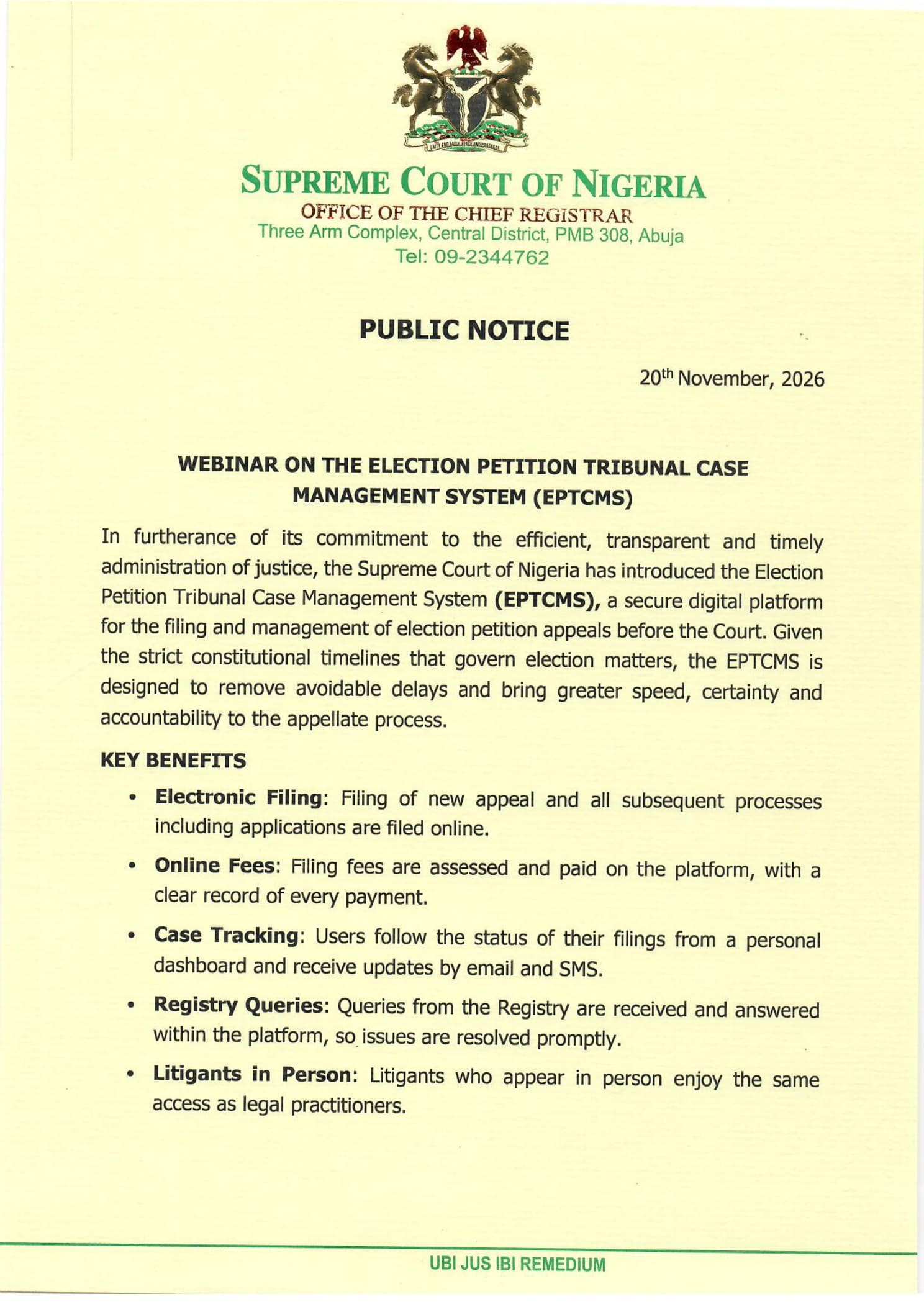
Chief Justice of Nigeria Kudirat Kekere-Ekun attended the launch, and Attorney-General of the Federation Lateef Fagbemi, SAN, set the bar by which he thinks the system should be judged: not the software itself, but whether it actually shortens waiting times, sharpens case management, speeds up the transmission of records, opens up easier access to court information, and gets appeals decided faster. He pointed to the current problems directly: slow filing and transmission of court processes, cases that are hard to track, and physical files that are cumbersome to manage. The platform, he said, has to be reliable, secure and genuinely easy to use, with proper infrastructure, training and a working channel for fixing problems when they arise, and he warned that the switch must not become a burden on litigants or lawyers who are not yet comfortable with electronic filing. Recalling that he praised similar Supreme Court practice directions back in October 2026, he called on the National Judicial Council, the Nigerian Bar Association and others to treat this as one coordinated national push rather than a series of separate projects, and pressed for modern courtrooms, automated case tracking, secure digital archives and virtual hearings across the board.
Speaking for the NBA President, the Association's Second Vice President, Nuhu John Egya, called the platform more than a technical upgrade, describing it as a genuine step toward a more efficient and accountable judiciary. He raised three concerns he wants the rollout to address: making sure lawyers in remote areas are not left behind, proper training and technical support for both lawyers and court staff, and reliability around technical faults, payment problems and the confidentiality of court records. "Technology must never become an obstacle to justice," he told the gathering, adding that the NBA wants continuing input into the system as it expands so practitioner feedback can shape it.
Dongban-Mensem credited the Chief Justice for leading a comparable rollout at the Supreme Court, and thanked the Judicial Information Technology Policy and Coordination Committee of the National Judicial Council, chaired by the Chief Judge of Borno State, Justice Kashim Zannah, for building the underlying system. Fagbemi closed by saying he hoped the platform would mark the start of a new chapter for appellate justice in Nigeria.
Was this story helpful?


Responses (0)
No comments yet. Be the first to share your thoughts.