

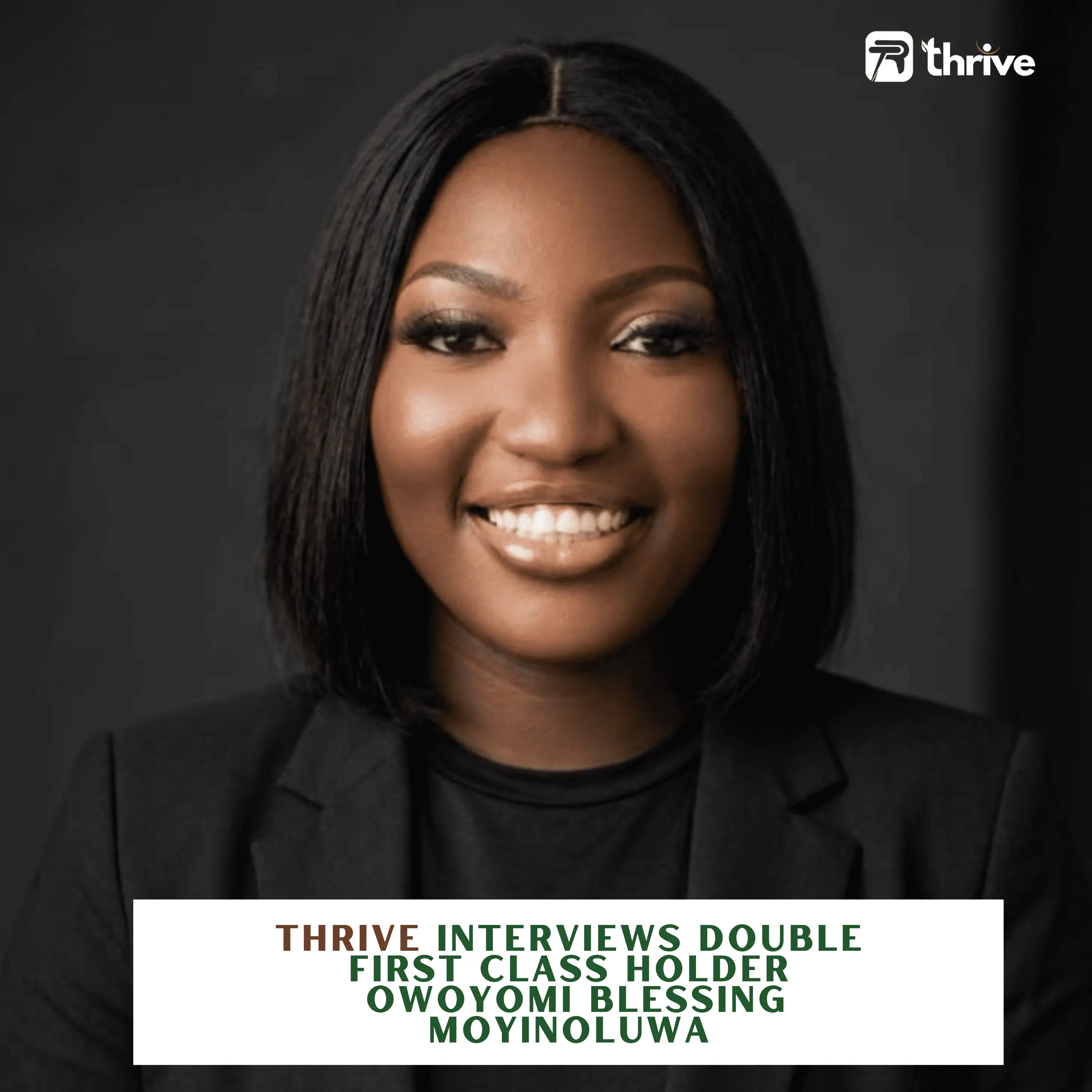
We’re glad to have you here. Thank you for joining us!
Background
Would you like to introduce yourself to our readers?
My name is Owoyomi Blessing Moyinoluwa. I am a lawyer. I genuinely just wanted to be someone who does well and makes an impact on people’s lives. I have always wanted to be a picture of possibility to anyone who has ever aspired to be great. I grew up in Kogi State, and from a young age, I was always drawn to intellectual challenges. I have always won awards and prizes since secondary school. I graduated from Nasarawa State University, Keffi, with a first class , a CGPA of 4.53 out of 5.0, first of its kind in the faculty and the best graduating student in my set,, and I recently graduated with a First Class from the Nigerian Law School Bar Final Examinations. I am simply someone who refused to give up, whether the odds were in my favour or not. I only wanted to do well, make God and those counting on me proud, and show that greatness is possible.
1.Why did you choose to study law, and have you decided on an area you would like to specialise in?
Law was not the plan from the onset. I chose to study Law because I enjoyed Art subjects in secondary school, and I loved writing. Reading was simply part of my nature; I have always enjoyed learning, exploring ideas, and challenging myself intellectually. At the time, I did not know exactly where that path would lead me, but it eventually became a journey that shaped who I am today. I am particularly interested in the intersection between law and technology. It is a progressive journey, and I know I still have a lot to learn, but I will get there.
Study Strategies & Habits
2. Can you walk us through a typical week at university and law school? What did your days actually look like?
I did not have a particular schedule or rigid timetable. I simply tried my best to read every day. If I did not feel great in the morning, I made sure I read in the afternoon, and if I could not read in the afternoon, I read at night. I usually read the topic before going to class, attended lectures, paid attention, and took detailed notes. I did not have many friends, so I often stayed in my room after lectures, where I could study, rest, and have some quiet time. I also made sure I got the rest I needed every day because I understood that I needed to be well-rested to function at my best. I started my day with prayer, and on days when there was a church service, I attended church in the evening. I did not have a perfect routine; I simply remained consistent, did my best every day, and made sure I kept moving forward.
3.What would you say has been the biggest factor behind your academic success?
God has been my biggest factor, and my desire to be a picture of possibility has also been a major driving force. I have always wanted my life to show others that what may seem impossible is possible, and that with God, determination, and consistency, you can go further than you imagined and also I usually read the topic before going to class, paid rapt attention in class, and solved the pre-class tasks. I was guided by what my lecturers taught, not by what I thought they had missed or what a textbook said instead. I studied the marking schemes because I realised that an A grade comes from knowing what the examiner wants, not from the bulkiness of your notes. I prioritised rest and made sure I got the rest I needed every day because I understood that I needed to be well-rested to function at my best
4.How many hours did you typically study each day, and did this change as exams approached?
I wasn’t counting honestly, I simply tried my best to read every day. I had study and recall hours, but I studied at intervals, depending on what was needed for that day. I would study to understand a topic and then spend parts of the day recalling what I had learnt to determine what I could actually remember and what I could not. If I did not feel great in the morning, I made sure I read in the afternoon, and if I could not read in the afternoon, I read at night. This approach did not change during examinations; I simply remained consistent with what worked for me
5.How did you decide what to prioritise when you couldn’t do everything?
Early in Law School, I resumed four weeks after the session had already begun, so I knew I had to cover a lot of ground. I understood that legal knowledge is built progressively; you have to understand the foundational topics before you can properly grasp the more advanced ones. I had learnt this from my university days, so I prioritised the foundational topics and made sure I understood them thoroughly. I also prioritised learning the authorities alongside the principles. As I studied each principle, I made sure I understood the relevant authorities supporting it, because this gave me a fuller picture of the law and helped me build knowledge that I could confidently rely on.
Life Outside Academics
6.What do you enjoy doing outside academics, and how do you make time for it?
I watched movies, went to church, and slept. I genuinely enjoyed watching movies, so whenever I noticed that I was getting too stressed, I would simply watch a movie and unwind. However, I was intentional about not watching series during Law School. I stuck to one or two hour movies so that I could relax without allowing it to take too much of my time.
7.How did you balance academics with your social life, rest, work, or other commitments?
Prioritising my time was something I struggled with, especially when I first got to Law School. I honestly did not have much of a balance at the beginning because I had already fallen behind on a lot of teachings and needed to catch up. However, as I settled in, I gradually tried to make more time for social activities. I am not really the type to go out often, so my personality probably helped a little. I simply found a balance that worked for me and allowed me to focus on my studies while still making some time for myself.


8.Do you have mentors or role models who have influenced your journey, and what impact have they had?
Yes, I did. I had senior friends who made a huge impact on me by constantly keeping me on my toes. They could call me at any time and ask me questions from virtually any topic, so I always had to stay prepared and keep learning. I also had a mentor I could call whenever things became difficult. He was always there to encourage and comfort me during challenging moments. My family was also a very important part of my support system. Their encouragement, presence, and belief in me gave me the strength to keep going, especially when things became difficult.
Setbacks & Resilience
9.Did you ever encounter a course or topic that was particularly challenging? How did you push through it?
I once encountered a topic in Corporate Practice that I simply could not understand. I read it in the morning, went back to it in the afternoon, and studied it again at night, but it still did not make sense to me. At that point, I prayed to God and decided to step away from the topic for a while rather than become frustrated. I focused on other courses and returned to it later with a clearer and more refreshed mind. Surprisingly, when I came back to the topic, it became one of the easiest topics for me in that course.
That experience taught me that perseverance does not always mean forcing yourself to keep doing the same thing. Sometimes, it means knowing when to step back, regain clarity, and try again. I have always been someone who does not give up easily, and that experience strengthened that quality in me.
10.Was there ever a point when you doubted yourself or felt like giving up? What kept you going?
There were many moments when I doubted myself, but there was never a point when I felt like giving up. My question was always, “What do I need to do to keep going?” rather than, “Should I stop?”
What kept me going was my belief in God and my track record of consistency. I had experienced moments when I did not feel good enough or capable enough, but I had also seen God help me through those moments. Looking back at those experiences reminded me that difficult moments were not necessarily an indication that I could not succeed. They were moments I had to work through. My previous experiences of overcoming challenges became a source of confidence for me. They reminded me that I had been through difficult situations before and had come out stronger. So, even when I doubted myself, I held on to my faith, trusted the process, and kept moving forward.
Reflection & Advice
11.What is one lesson from university and law school that you wish you had learned earlier?
I am already what is needed, I simply need to become better at being myself. Sometimes, the issue is not that I lack the ability, but that people have not had the opportunity to see what I am capable of. For me, I think part of that growth means putting myself out there more, being more intentional about showing up, and allowing my abilities, ideas, and potential to speak for themselves.
12.What advice would you give someone who feels like they’re working hard but not seeing the results they want?
You are honestly not the problem; your strategy might just be the problem. You may not have connected with or assessed yourself enough to understand what works best for you. Sometimes, we spend too much time following other people’s strategies without taking the time to understand ourselves. Pray to God, assess yourself, experiment with different approaches, and pay attention to what works for you. If you do that consistently and long enough, things will definitely get better. You just need to find the strategy that works for you.
13.What are you currently doing, and how have your education and experiences prepared you for it?
I am currently working as a Legal Assistant to a Court of Appeal Judge while also completing my National Youth Service Corps (NYSC). My educational journey taught me the importance of diligence, perseverance, consistency, and the courage to pursue whatever I set my mind to. These values have shaped the way I approach responsibilities and challenges, and they prepared me for the demands of my current role. I have learned to remain committed even when things are difficult, to keep improving myself, and to approach every opportunity with discipline and purpose.
14.Where do you see yourself in the next 10 years?
I see myself becoming someone who is full of possibilities, regardless of where I find myself. I want to be someone who creates meaningful impact, makes a difference in the lives of others, and uses whatever opportunities and abilities I have to contribute positively to society. Finally, I want my growth and success to extend beyond me to be able to give back, open doors for others, and leave a meaningful impact wherever I go.
Thank you so much for taking your time to attend this interview, we wish you a successful global career.



No comments yet. Be the first to share your thoughts.