
2026 DLA Piper Global Scholarship
DLA Piper
Quick Information
Institution
DLA Piper
Country
United Kingdom
Level
Internship
Field
Internship
Type
Undergraduate - Masters - Post Graduate
Award
Full Scholarship | Living Stipends | Travel Costs | Laptop | Accommodation
Deadline
Nov 30, -0001
Status
active
Latest Career Insight
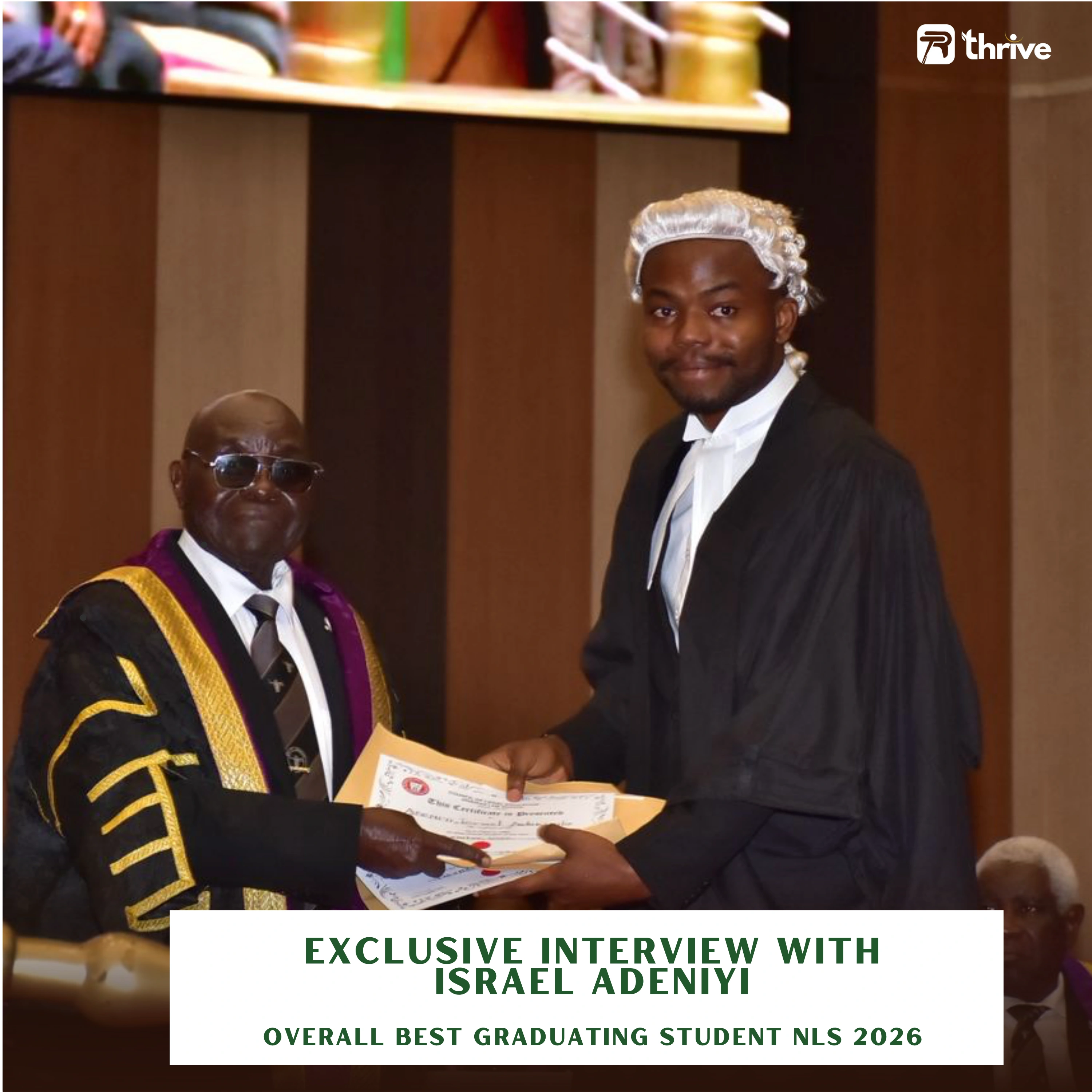
From a D-Grade Scare to Best Overall Student: How Israel Adeniyi Topped 6,009 Candidates at Law School
Background1. Would you like to introduce yourself to our audience?My name is Israel Adeniyi. I am a lawyer. I am someone who has always been driven by an insatiable curiosity to understand how systems work and how they can be improved. I grew up in Kwara State and from a young age, I was always drawn to intellectual challenges. I was the secondary school valedictorian. I graduated from the University of Ilorin with a CGPA of 4.83 out of 5.0, which is the highest in the history of the Faculty of Law. I recently emerged as the Best Overall Student among 6,009 successful candidates at the Nigerian Law School Bar Final Examinations. I was honoured with twelve academic prizes. Beyond the titles and the prizes, I am simply someone who refused to give up, who trusted the process and who believed that with faith, hard work and the right support system, impossible truly becomes I'm-possible.2. How did you feel when you found out that you had emerged as the overall best student at the law school (and at the University)?I felt a profound sense of gratitude but mixed with disbelief. Gratitude because I knew that this was not my doing alone. It was the product of years of sacrifice, of late nights, of countless moments of doubt transformed into determination. Disbelief because when I walked into the Nigerian Law School, I knew the reputation that preceded the institution. I knew the history. Since the inception of my university in the early 90s, only one student had made the double barrel of graduating as the best student at both the university and law school and that was in 2015. So I did not take anything for granted. When my name was called and I shook hands with the Chief Justice of Nigeria and other distinguished members of the Body of Benchers, I had to pause and let the weight of the moment settle.3. Was becoming the overall best something you planned and prayed for, both at university and at law school or did it happen unexpectedly?I would say it happened unexpectedly but unexpectedly in the sense that I did not chase it. I planned to do my possible best to make a first class at the Nigerian Law School. I prayed for the strength to keep going, for the wisdom to understand and for the grace to persevere. I set out to leave nothing on the table. I wanted to look back and say, "I gave it everything I had." The result, being announced as the overall best, was not something I planned from the beginning. It was something that gradually became a possibility as I saw how my preparation was translating into performance. But I never allowed myself to become complacent. I kept my head down, kept working and kept trusting the process. The result was not something I chased. It was something that came because I stayed focused on the work.Study Strategies & Habits4. Can you walk us through a typical week at university and law school? What did your days actually look like?For my typical day, I woke up early, prepared for the day and attended lectures. The lectures were long and intensive, so I made sure to pay rapt attention and take detailed notes. I solved the pre-class tasks directly in my notes. I copied the slides and ensured my notes were always up to date. At some points, when the class moved so fast that I missed a slide, I would search for it afterward and fill in the parts I missed.I did not have a rigid timetable, but I had goals. I would say, "By the end of this week, I want to have covered XYZ," and I worked towards that goal at my own pace. I prioritised rest. I slept at least six hours every day. I also made time for social media and relaxation, because I knew that my brain needed rest to function optimally. I watched football on weekends. I understood that consistency, not long hours, is what wins.5. What would you say is your secret to success and academic excellence?I would not call it a secret because I think that implies something hidden or magical and my approach was neither. It was about discipline, consistency and intentionality. I paid rapt attention in class. I solved the pre-class tasks. I was guided by what my lecturers taught, not what I thought they missed, not what a textbook said instead. I studied the marking schemes because I realised that your A grade comes from knowing what the examiner wants, not from the bulkiness of your notes. I prioritised rest. I think the real secret is having faith and trusting the process. I held on to the belief that if I did my possible best, the results would take care of themselves.6. How many hours did you typically study each day and did this change as exams approached?I did not count hours. I counted understanding. There were days when I studied for hours and felt like I had achieved nothing. There were days when I studied for a short time and felt like I had mastered a concept. I focused on quality, not quantity. As exams approached, I did not increase my hours drastically. I became more strategic. I focused on revision, practice questions and consolidating what I already knew. I trusted the preparation I had done and focused on fine-tuning my approach.7. What is one study habit you think most people underestimate?Paying rapt attention in class. This sounds simple, but it is actually rare. Most people are distracted. They are mentally checked out during class because they think they will go and form their notes after class. I made a conscious decision to be fully present in every class. I listened to what my lecturers said, I wrote down everything that was important and I asked questions when I did not understand. This meant that by the time I got to revision, I already had a solid foundation. I did not have to start from scratch. That small habit of being fully present paid huge dividends.8. How did you decide what to prioritise when you couldn't do everything?I prioritised based on what was most important and what would give me the most marks. I studied the marking schemes to understand where the marks were allocated. I focused on the core principles and the most frequently tested areas. I also prioritised understanding over memorisation. If I could understand a principle, I could apply it to any scenario. That was more valuable than trying to memorise everything and ending up overwhelmed.9. Did you use any tools, apps or systems to stay organised or was it mostly discipline?It was mostly discipline. I did not use any special apps or tools. I used my notes, my slides and the materials provided in class. I did not make separate personal notes. I did not rewrite my notes for the sake of making them look clean. I focused on content. I also used practice questions and marking schemes to test my understanding. But the real system was discipline. The discipline to show up every day, to pay attention, to do the work and to rest when I needed to.Life Outside Academics10. What is your social life like and what do you enjoy doing outside academics?I socialise. I watch football on weekends with my friends. I am active on social media. I also spend time with my family and friends. I do not believe that academic excellence requires isolation. I believed in balance. I also enjoyed reading non-law books like history, literature, politics and leadership books because they give me perspective and help me think widely.11. How did you balance academics with your social life, rest, side hustles or work?I was intentional about balance. I did not let academics consume me completely. I made time for the things I enjoyed. I maintained friendships. I understood that my brain needed rest to function optimally. I also gave myself grace. There were days when I did not study as much as I wanted to and I accepted that perfection is not possible. The key was consistency over the long term, not perfection in the short term.12. Which books do you enjoy reading besides law books?I enjoy reading history, politics and leadership books. I also enjoy biographies of people who achieved extraordinary things because they remind me that the only limitation to what I can achieve is the limitation I place on myself. I find that reading widely helps me think more creatively and see connections that I might otherwise miss.13. Do you have mentors or role models who have contributed to your success and do you mentor others?Yes, I have been fortunate to have mentors who believed in me before I had proven anything. And, I do mentor others. I believe that success is not truly success until it is shared. I am committed to paying it forward, to showing young people that excellence is possible regardless of their background.Setbacks & Resilience14. Did you ever encounter a course or topic that nearly broke your streak? If so, how did you push through it?My most difficult stretch came during my first year at university, when a poor first-semester result, especially a D grade in a European literature course, rattled my confidence. Rather than dwell on it, I pushed harder. By my second year, I had risen to the top of my class, recorded a perfect 5.0 GPA four times, and eventually graduated from the university with a CGPA no other law student there had ever achieved.15. Was there ever a point when you doubted yourself or considered giving up on your goal? What kept you going?Yes, I doubted myself many times. There were moments when I felt like I was not good enough, when I feared that I was going to fall short. But what kept me going was the belief that I had come too far to give up. I had put in years of work. I had sacrificed so much. I refused to let that work go to waste. I also thought about the people who believed in me. My family, my mentors and my lecturers. I did not want to disappoint them. I believed that God had brought me this far and would not abandon me. That belief gave me peace when my mind wanted to spiral into anxiety.Reflection & Advice16. Why did you choose to study law and have you decided on an area you would like to specialise in?I chose law because it is dynamic, challenging and boundless. Law challenges you to think critically, to think strategically, to think about how rules shape human behaviour and society. There is no limit to what you can explore. I love the intellectual challenge of it. I also saw how law touches everything: business, governance, human rights, even our daily interactions and I wanted to understand how it all works and how I could use it to make a difference. 17. What advice would you give someone who feels like they're trying hard but not seeing the results they want?I would say: do not confuse effort with effectiveness. It is not about how hard you are working. It is about whether you are working in the right direction. Ask yourself: are you studying the marking schemes? Are you understanding the principles or just memorising? Are you resting enough? Are you comparing yourself to others? Sometimes, the problem is not a lack of effort but lack of strategy. So take a step back. Evaluate your approach. Be honest with yourself about what is working and what is not. And do not give up. If you keep showing up, keep adjusting and keep trusting the process, the results will come.18. What are you currently doing and do you think your education and experiences so far have prepared you for it?I am currently an Associate at Aluko & Oyebode. I am learning from some of the finest minds in the profession, gaining practical experience and building a foundation for a meaningful career. I believe my education and experiences have prepared me well not just the academic knowledge, but the discipline, the resilience and the strategic thinking that I developed along the way. But I also know that learning never stops. I am approaching this next chapter with humility and a willingness to learn.19. Where do you see yourself in the next 10 years?In the next 10 years, I see myself as a leading lawyer. I also see myself as a thought leader, someone who is writing, speaking and influencing the direction of legal practice in Nigeria. I want to be involved in policy reform, to use the law as a tool for social change and to mentor the next generation of lawyers. I want to build institutions that will outlast me. I want to continue learning, growing and pushing the boundaries of what I am capable of.
About the Scholarship
Eligibility Criteria
Latest Career Insight

Now That You’ve Gotten That Interview...
Now that you’ve gotten that interview, congratulations. You are already halfway there. Getting to the interview stage means your application stood out and caught someone’s attention. But now, it is time to do the real work.The interview is where your story meets your voice. This is where you get to prove that everything they read about you on paper is real. The first thing you should do is research. Look for information about that kind of interview. Find people who have done similar interviews, whether for the same company or for similar roles in other organisations. Learn from their experiences and try to understand the kind of questions that are usually asked.If the company has given you information on what to prepare for, stick to that and build around it. But if not, find the closest match online or from people in your network. This gives you a sense of direction.Go further and prepare for other possible questions. Write out sample questions and structure your answers around them. However, do not over-rehearse. Be flexible enough to pivot when a question catches you off guard. If you have prepared well, you can adapt your existing ideas to fit new questions.Remember that first impressions matter. When they say, “Tell us about yourself,” or any other opening question, that is your chance to set the tone. Prepare a solid answer that reflects your journey and shows that you are undoubtedly suitable for the role. Make it comprehensive yet natural.If a question catches you off guard, stay calm and composed. You do not have to know everything. Take a brief moment to think, say what you can, and move on confidently. Do not let one tough question throw you off balance. What matters most is how quickly you recover and maintain your confidence.Finally, keep in mind that an interview is not just a test of what you know but how well you communicate it.
The 2026 DLA Piper Global Scholarship scholarship is offered by DLA Piper with an application deadline of November 30, -0001. This opportunity covers Full Scholarship | Living Stipends | Travel Costs | Laptop | Accommodation. It targets Internship students. Discover more scholarships in United Kingdom on TRThrive.
Related Scholarships
Similar scholarships you might be interested in
-
Related Nov 30, -0001
2026 University of Oxford Clarendon
University of Oxford Clarendon UKFull Scholarship | £18,622 Living Stipends -
Related Sep 12, 2026
The Bridge Scholarship Program 2026 (Undergraduate)
The Bridge Scholarship Program NigeriaFully funded scholarship — covers tuition, living stipend, mentorship, and career development until graduation. -
Related Oct 01, 2026
Bridge House College Nigeria Law Scholarships 2026
University of Liverpool United Kingdom£2,000 -
Related Oct 31, 2026
2026 University of Melbourne Graduate Research Scholarship in Australia | Fully Funded
University of Melbourne AustraliaFull Scholarship | $39,500 Stipend/Yr | $3000 Relocation Grant -
Related Oct 31, 2026
2026 University of Melbourne Graduate Research Scholarship in Australia | Fully Funded
University of Melbourne AustraliaFull Scholarship | $39,500 Stipend/Yr | $3000 Relocation Grant -
Related Oct 31, 2026
Maxwell King Scholarship at Monash University in Australia 2026
Monash University AustraliaFull Scholarship| $53,608 Stipends per annum